Your expensive model directs. Cheap Flash delivers.

Each chunk is built by a cheap Flash model, then reviewed by a different model family before it can merge.

Claude CodeCodexDeepSeekGLMMiMoSStealthJevKimi

Delegated work, verified delivery.

Cheap workers carry each chunk, an independent reviewer checks it, and the state on disk lets you resume any session.

Verified before it merges

Every chunk is checked, then reviewed by a different model family, then accepted. Defects surface inside the run, not on your screen.

45 blocking defects independent review caught before merge, across the two runs that built this site.

Big-model direction, cheap-model cost

A top-tier model sets the plan and integrates; Flash workers carry each chunk, so implementation runs at worker rates.

7.82 US dollars estimated worker and reviewer spend for both runs, 156 model calls. A local estimate, not a billed figure; the coordinating model is not in it.

A crash is a pause, not a rewrite

The run lives on disk. Clear the session, kill the process, come back tomorrow: resume picks up where the work stopped.

Direct the work like a lead

Split a feature into independently deliverable chunks, write acceptance criteria that can be checked, and judge results at chunk boundaries.

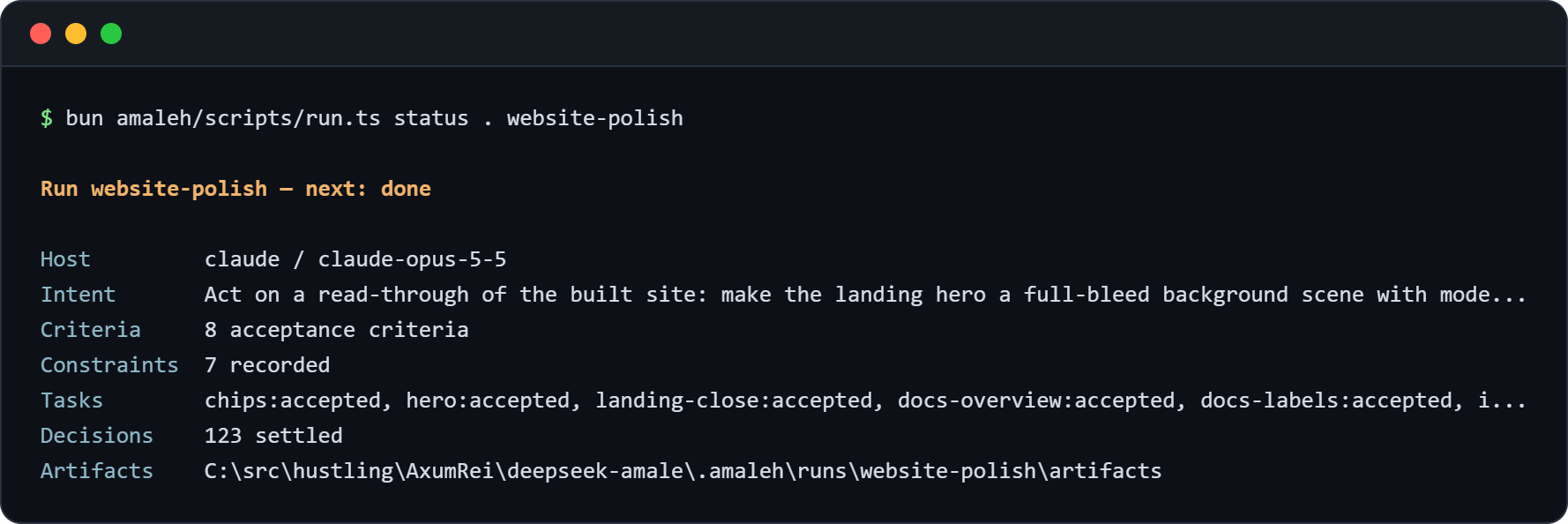
status for website-polishThe skill's own output

This site was rebuilt through Amaleh's own runs: 156 model calls, 45 blocking defects caught by review before merge, an estimated 7.82 US dollars of worker and reviewer spend.

The figures were read from the run records on 2026-09-23. The cost is pi's local estimate of the worker and reviewer calls, not a billed figure.

Read the case study

Terminal window showing the status report for run website-polish: the run marked done, with its host, intent, criteria, tasks, decisions and artifacts directory.
Run status for website-polish, one of the two runs that built this site.

Who does what.

The coordinator holds the direction. Everything inside a chunk runs without it and comes back as one outcome to inspect and integrate.

Brass marks the coordinator sending chunks out to the routed worker models. Violet marks the bounded questions workers put to Jev. Teal marks a chunk reviewed by another family and accepted back.

How it stays cheap.

  • Routing is deterministic. Round-robin across eligible model families, seeded by the run's session hash, so work spreads across vendors instead of fixating on one.
  • Only genuine boundaries escalate. Exhausted repair allowances (Flash to Kimi to host), missing evidence and ambiguous intent reach the expensive model; ordinary uncertainty goes to Jev.
  • Progress lives on disk. A closed session resumes from disk on the next invocation, with its artifacts still in place.
accepted chunkCoordinatorClaude Code · CodexFlash poolDeepSeekGLMMiMoStealthrouted per chunkReviewerread-onlyJevbounded decisionsKimideeper specialist1 delegate2 consult3 review4 escalate5 return
One chunk, end to end: Claude Code or Codex hands a chunk to a routed Flash family — DeepSeek, GLM, MiMo or Stealth — Jev answers bounded choices, the other family reviews read-only, exhausted repairs escalate to Kimi, and the accepted chunk returns.

Coordinator

minimal turns

The expensive model, kept to minimal turns. Clarifies intent, chunks work, defines acceptance criteria and integrates results. One delegate call per chunk.

Workers

routed Flash pool

The routed Flash families (DeepSeek, GLM, MiMo and Stealth) each own a chunk end to end: implementation, checks and repair cycles. Uncertain inside the chunk, they consult Jev directly instead of escalating.

Reviewer

read-only

Always the other model family, reading only. It verifies each chunk with structured coverage and routes findings back into the worker's repair loop rather than to the coordinator.

Jev

bounded decisions

A cheap decision model answering bounded either/or questions for workers and the coordinator. TypeScript code, not any model, enforces dependencies, ownership, checks and review coverage.

Two commands to install.

Clone the repository and run both commands from the checkout root. Invoke /amaleh with your task afterwards; the skill handles the workflow and resume steps.

shell
git clone https://github.com/mhamri/amaleh
cd amaleh
bun amaleh/scripts/run.ts doctor
bun amaleh/scripts/run.ts install

What install actually does

  • Links, never copies. Install links the canonical skill directory into the default Claude and Codex skill directories, so the checkout stays the single source of truth.

  • Refuses conflicting targets. A conflicting destination is refused rather than overwritten, so an existing installation is never silently replaced. Keep the checkout in place afterwards.

  • doctor checks local setup before anything network-facing; the startup preflight covers network connectivity separately.

  • Fallback launcher. Node 24 or newer runs the erasable TypeScript directly when Bun is absent, so the same commands work without a second toolchain.

Credentials

Never in the repository

Configure pi with OpenRouter, or provide OPENROUTER_API_KEY through your environment. The runtime reads existing credential configuration and never prints or writes the key into artifacts.

Portrait of Mohammad Hossein Amri

Get connected.

Amaleh is built by Mohammad Hossein Amri, a software engineer in Kuala Lumpur, Malaysia. He has over 13 years in the industry, works at menumiz (AU), and writes C#/.NET, TypeScript and cloud applications. He built Amaleh to direct cheap models instead of typing every edit with an expensive one.

The name is the Persian word عمله, pronounced Ah-mah-leh, meaning workers or laborers.

Read before you trust it.

Five documentation pages take the workflow apart, and the case study proves each claim with measured figures from the runs that built this site.

Documentation

Five pages
  • The problem
  • Getting started
  • The workflow
  • Review and recovery
  • Command reference

From the problem Amaleh solves through installation, the workflow, review and recovery, to a command reference drawn from the skill's own reference files.

Read the documentation

Case study

Measured, with limits

Each claim this page makes, paired with a figure from the run records: 156 model calls, 45 blocking defects caught by review, an estimated 7.82 US dollars of worker and reviewer spend, and the honest limits beside them.

See the case study

Primary sources

Eight files
  • planning.md
  • execution.md
  • review.md
  • runtime.md
  • parallelism.md
  • recovery.md
  • verification.md
  • effort.md

The skill's reference documents ship unchanged with this build, where every claim on this site is written out in full.

Browse the sources

The skill, its source and its issues are on GitHub.

Direct the next build.

Install once, invoke /amaleh with your task, and get back work each chunk of which was checked and independently reviewed.

First run
git clone https://github.com/mhamri/amaleh